Friday, 9 December 2022

The Lost Kingdom Of New York

New York City skyline with Empire State

For the audio version of this story, click here (YouTube) or here (Spotify) or here (Anchor).

* * *

He emerged from Grand Central and walked steadily.

Rockefeller Center is not Greek, but it suggests the balance of Greek architecture. It is not Babylonian, but it retains the flavour of Babylon’s magnificence. It is not Roman, yet it has Rome’s enduring qualities of mass and strength.

He did not know where, but he had to go. 

Summoned by a longing beyond his reach, he let it control him. Hurriedly, he circled past bystanders marvelling at a towering sight behind him. He shot a cursory glance at that art deco steeple impatiently. A moment later, he turned and continued walking. 

Despite its impudence, despite its audacity, the Chrysler would have to wait.

Nor is it of the Taj Mahal, which it resembles in mass composition, though in it has been caught the spirit of the Taj — aloof, generous in space, quieting in its serenity.

He shuffled north on 5th Avenue, picking up pace with each step. He pushed past pedestrians, drawn to his purpose, delirious with desire.

There is no easy way from the earth to the stars. 

The Taj Mahal lies in solitary grandeur on the shimmering bank of the Jumna River. Rockefeller Center will stand in the midstream rush of New York. The Taj is like an oasis in the jungle, its whiteness tense against the gloomy greenness of the forest. 

He started jogging. He did not stop or apologise when he crashed into a group of people. The St. Patrick's Cathedral loomed ahead, but he kept up the pace. He didn't deem the Cathedral worthy of even a cursory glance. It can wait too. 

He broke into a sprint. 

He swerved left midway through the block, almost like he had to, almost like there was no other option, no other choice, no other purpose.

Rockefeller Center will be a beautiful entity in the swirling life of a great metropolis — its cool heights standing out against an agitated man-made skyline. And yet the two, far apart in site and surroundings, are akin in spirit.

Finally, he saw it, looming like a monolith, framed by the Channel Gardens. 

"The King of New York?" he whispered, fixated on the Rockefeller, fiery in the sunset.

* * *

 "Somehow, from the beginning, mujhe badhe shehron se dar lagta tha."

(I used to be afraid of big cities)

A month before I left Dubai, I decided to interview my parents. 

Frankly, this 'interview' was just a front to probe them about their lives and decisions.  

When I left for university in 2012, I departed as their son, the youngest in the house. When I returned four years later, I gradually matured into an equal, a friend (or so I think). 

It was new territory for me. 

In my entire childhood and teens, the idea of 'home', of 'family', had lapped around a parent-child dynamic. Now it was three adults under one roof. For the first time, I addressed my parents like an adult. For a change, our conversations started to be about them. I asked them countless questions about their childhood. I made them recount memories of their parents, days in school and college, relationships and friends. Spurred with bravado, I poked them to reflect on significant decisions, parenting or otherwise. 

I probed their fears. 

They had always been 'parents': omnipresent, omniscient and omnipotent. They had spent two decades diligently moulding me into a barely acceptable human. Now, I was back to find the human in them. On a whim, a month before I left, I decided to interview them formally. But it wasn't just an interview for me. I considered it an encapsulation, no, an immortalisation of the last five years.

On a sultry July afternoon, I sat across from my father at our rustic coffee table, 'interviewing' him. In the middle of a story I had heard a couple of times before, he added:

"Mujhe badhe shehron se dar lagta tha."

I looked up in surprise.

My father, fearless, a pillar of strength and composure, my unfailing backbone in distress... 

...afraid? 

The man who uprooted a comfortable life twice, once from Agra to Muscat, and then from Muscat to Dubai, each time to get into a bigger city, a bada sheher. The man who did it with solidity on both occasions. With determination and courage, lots and lots of courage. All driven by a desire to give his family a better life. That it was all built on fear, and the desire to avoid ceding the same fear in his sons, needed more courage than I had ever imagined. 

I found it hard to believe. It was so un-parent. It was so undeniably, indisputably human that I got caught off guard. As I collected my thoughts, he resumed narrating his original story. Sensing a brief window, I interrupted him.

"Can I ask, what was this fear?" I asked, watching him intently.

"Bade sheher ka?"

"Haan."

"I used to feel lost."

* * *

Museum Of The Future Dubai UAE

It's 3 AM, but Dubai will never betray the time. 

I'm sitting on a sidewalk at Sheikh Zayed Road. 

The road of kings must be a golden blur of trailing lights. The air in front of me must be rent with the whoosh of cars flying past at speed. Mouths yakking in Arabic, Hindi, Urdu, Tagalog or Bengali must be puncturing the air behind me. The sidewalk must be swarming with pedestrians and shisha cafes. No matter how deep into the night we go, the Dubai stretch of the E11 is always alive. 

I have consciously picked a spot where I can see the Emirates Towers. But they must be partially blocked by the fluidic, glistening Museum Of The Future. If I look to the right, I should be able to spot the Burj Khalifa in the distance. 

But I don't spot it. I don't see the towers, museum or the highway. I don't hear the cafe patrons or the soaring cars. I don't see any of it. The Sheikh Zayed Road, the promenade of mighty sentinels, had always evoked feelings of wonder, awe and ambition in me. But tonight, I don't feel it.

Because I'm crying.

Tu bin bataye, mujhe le chal kahi

Jahaan tu muskaraye, meri manzil hai wahi

It's the night before I leave Dubai. I hate the night for it. 

I have to leave. I hate time for its stubbornness. 

One of my closest friends scribbled on a farewell card, "Sometimes the places we love become too small to hold our dreams." I hate that it is true, every bit of it.

I hate that I feel helpless. I feel alone, but I hate that this city, the city that truly never sleeps, is alive around me. 

I feel hollow, but I hate that Dubai will never betray my darkness.

bheeg jaye mere, khwabon ka kafila

jise tu gungunaye, meri dhun hai wahin

* * * 

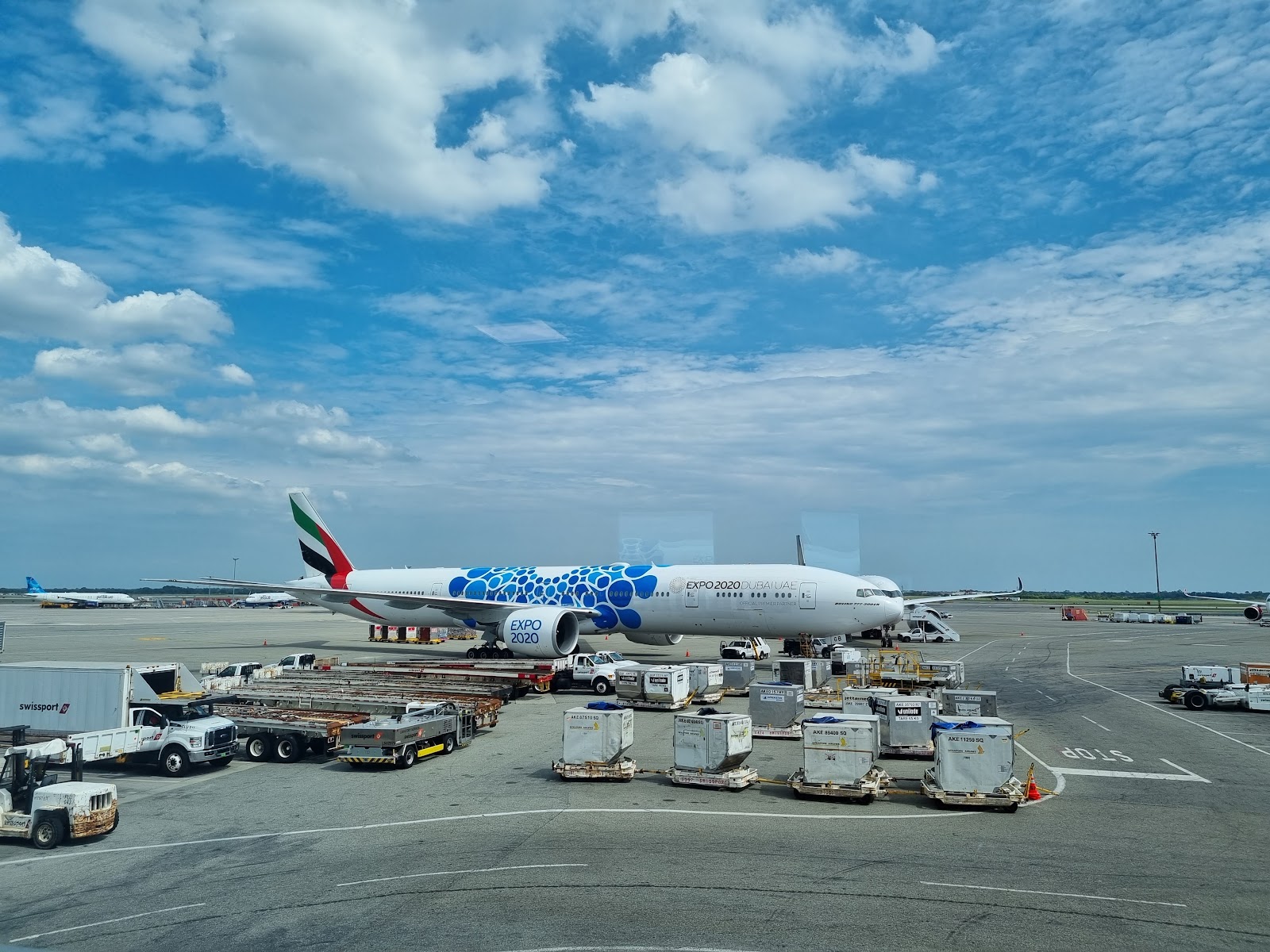
I landed at JFK Airport, and I was born again. 

All my life, I've just been reacting to the mise-en-scène. I didn't miss Oman, the place or the people, after I left it. Or Dubai when I escaped for the first time. Or Manchester. Or Cambridge.

I thought this time would be different. How could it not be? I had never not wanted to leave, the place or the people, so strongly. I had never felt regret and sorrow like this before. It had to be different this time. The richness of my memories, the novelty of my love, and the depth of my grief would engrave this landmark breakthrough in my emotional maturity. For a person who never cared before, this time, it would be impossible to not care...

...and yet, I didn't.

Just fourteen hours later, as I sat on my suitcase at JFK, watching taxis roll by, I realised I had relapsed into apathy once again.

A Sikh driver got out of his yellow cab, aviators glinting in the sunlight as he strutted towards me.

I landed at JFK, and I never looked back. In the months to come, I spoke of Dubai and thought of it often but never wished that life back, as perfect as it was. It was no longer a part of me. A month later, I tried to remember, relive, and wallow in the richness of my memories. I tried to dive back into the depths of my love and grief. 

But in just a month, I couldn't feel a thing. 

It was dead. 

Gradually, a single thought, pernicious and pervasive, started crawling like dark tendrils in my mind. It snaked through like a vine, accelerating in speed and coagulating in thickness. It took hold, grasping tighter and tighter over the months, and never let go.

That it was inhuman to be so cold, so indifferent, so apathetic.

* * *

I'm lugging up my suitcase in a pre-war walk-up in Upper West. As I stop at a landing to catch my breath, a diminutive wizened man steps out of his apartment. 'I Voted For' stickers pepper his door. A keychain with at least twenty keys jangles at his buckle. 

"You moving in, guy?" he rasps. I nod, still bent over, panting heavily. He asks me my name and apartment and grunts in response. I flash him a smile in between deep breaths, trying to befriend my new neighbour. 

He doesn't smile back. 

He shuffles across and starts descending. As he leaves, I try to slink in some last-minute questions punctuated by my exaggerated panting.

"What's your name?" I huff.

"Everyone calls me Lefty," he barks as he continues descending.

"Where are you from?" 

"Puerto Rico."

I ask no more. He stops, turns around and locks eyes.

"But I've been around New York seventy-three years, guy."

* * *

Woke up today and the sun was shining

I said Mr Sun

Where have you been?

It's my first morning in the city, and I'm out to get a bagel. A line stretches across the block for Absolute Bagels, and I join the rear. I resist the urge to Google the best bagel on the menu. Now that I'm in NYC, I've committed to striking up random conversations with strangers. I tap the lady in front of me.

"I'm sorry to bother you, but have you been here before?"

She's a middle-aged woman with short hair, bright eyes, a pleasant smile and round glasses. She's delighted to hear that it's my first day in New York. She peppers me with questions about Dubai. I struggle to find an opening to question her instead, and I finally get one.

"What about you? What do you do?"

"Oh, I'm just a personal assistant to an actor," she said dismissively, waving her hand nonchalantly. She launches into a question about Dubai's heat like her answer was anything but matter-of-fact. An actor? Is this normal, New York? Do people bump into entourages all the time? It was my first day out, my first encounter, and it was already unconventional by my standards.

"Which actor?" I feign casual interest. 

"Elliot Page."

I make a mental note that this is pushing it, even for my first story in the city. We continue talking about Dubai's heat, Brad Pitt's tweet and Columbia's feat. We reach the counter, and I mimic her suggestion: an everything bagel, butter and toasted, chives and garlic cream cheese. As I pull out my wallet, she taps my arm and says she wants to buy me my first bagel in the city. I resist, but she is adamant. She refuses flat, hands over the cash to the server and hands me my bagel. 

"Why?" I protest.

"I cannot explain it fully, but I had to get it for you. It just feels right, you know?"

* * *

That evening, I was walking outside Madison Square Garden. A neon blue Mustang pulled up on the road. The signal turned green, and the driver revved to make the exhaust sputter like a firecracker.

A black man across the street robotically dropped to the ground and covered his head. 

He hadn't seen the car. He had only heard what he thought were gunshots. A few seconds passed, and he got back up and continued walking like nothing had happened. 

Like it was normal. 

Just routine, duck when you hear a shot, cover your head, say a prayer and carry on with your day.

I got to show you the dark

So you can really feel the light

You know

In just a day, I had seen two different Americas.

* * *

"I have a lot of respect for this city. This city will make you respect her."

I said nothing in return to her. 

My university had launched a free nightly cab service for students around campus since getting shot is always a tangible possibility on any given night in this city. I used the cabs flippantly, spotting an opportunity to 'earn' back some of my investment into this vacuous degree. The campus and surrounding neighbourhoods were assigned a fixed number of cab drivers, so we knew them all. They were local celebrities. 

That is how I met Geneva, an older woman with the vivacity of a teenager. For a year, on many nights, often at the deathly hour of 3 AM, amid rain, snow, or other dangers of the night, she would slide up the street, unroll her window and give me a cheery greeting. Entering Geneva's cab meant that I was safe for the night. By the time I settled in, she was already telling me about her day. She always spoke at length, never unflustered by her passenger's response (or lack of it). 

I never saw her face. I don't know what she looks like, not enough to recognise her on the streets. I can only identify the back of her head, frizzled with grey hair, curls swaying around as she chatted animatedly. A giant surgical mask always concealed her face. The first night I met her, I asked her what New York used to be like decades ago. 

"She doesn't care if you love her," Geneva proclaims, almost lost in thought. "She has the tendency to take your love and throw it right back at you."  

I still said nothing. Geneva settled into rare silence as well. Her words still hung around, refusing to vaporise, sinking deeper and deeper. As the cab trundled down Morningside Drive, I stared blankly into the abyss of the park, pricked only by the distant lights of East Harlem. It was one of those pitch-dark nights in Manhattan, no wind, no cloud, no movement. Just eerie darkness, thick and resolute.

I gazed into the abyss, and the abyss was gazing back. 

* * *

I'm on the 1 train heading Upper West. It's midnight on a Saturday, so naturally, drunk students fill the carriage with their singing, giggling and fighting. It's your classic subway midnight pandemonium. To my left, a young man in a floral shirt and pair of shorts is sitting in silence. He's resting his legs on a giant suitcase, gazing into the distance, lost in wistful thought. 

"Are you flying somewhere tonight?" I ask.

"No." He sees me looking at the suitcase and adds, "I'm a magician. I'm coming back from a show."

Unprompted, he unzipped the front pocket of his suitcase and removed a deck of cards. He gave me an ace of spades and made it disappear. He asked me to look in my pocket, and it reappeared. I didn't tell him I was still marvelling at a better trick. That New York's ability to reveal a new life, marvellous in talent and origins, exotic in dimension, hitherto unimaginable that the 'man-next-to-me-on-the-subway' could be an artist, musician, actor, poet or magician. A new story just inches apart. I didn't come from places where this was common.

That was magic for me. No trick, no simple secret, no big giveaway. That wasn't just magic; it was real magic.

The train screeches to a halt at 110th. He lets me keep the card in my pocket. 

I step out and wave. 

"Wanna see the fastest trick in the world?" he shouts as the doors close. Through the window, I see him put a deck of cards in his mouth. He points to my pocket. I put my hand in to find nothing. As the train glides past, he sticks his tongue out, splaying all the cards against it. Only one card is facing up. 

It's the ace of spades.

* * *

Grief is the price we pay for love.

I first read those words on a pediment at the 9/11 Memorial Garden in London in 2014.

I thought of them again today, seven years later. That day, I read them. Today, I feel them.

As I sat on a slab at Ground Zero on the twentieth anniversary of the horrific attacks, for an hour, I knew the true meaning of poignancy. I could see families of victims standing by the pools, some openly weeping, some resting their heads and crying softly, some caressing the engraved names with eyes closed, some with their heads bowed. 

The 9/11 museum has audio tapes of victims calling their family one last time, reassuring them even though their voice betrays the inevitable. Leaving a message behind for everyone they ever loved as death crept closer and closer. The museum has a backpack that a mom painted for her child's first day of school that she never got home to hear about.

As I sat on a slab at Ground Zero, I felt their sorrow like it was mine. Their grief was so heartrending, so powerful, that it trickled out of them all and coalesced into a layer that permeated the hearts of every person there that day. It was that mother who wept inconsolably in that corner, but it was that crowd, that nation and that world that collectively mourned that day.

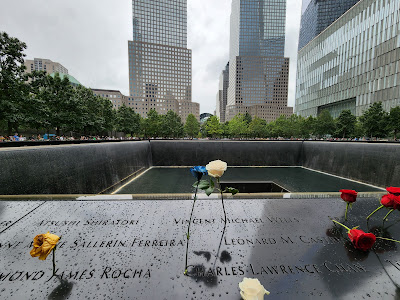
I walked up to the memorial. There, framed against the backdrop of the Memorial Pools and the Freedom Tower, I spotted a solitary rose wedged into the engraved name of a victim.

Beside it was a drop that couldn't be anything but a tear.
All you who sleep tonight
Far from the ones you love,
No hands to left or right,
And emptiness above –
Know that you aren’t alone.
The whole world shares your tears,
Some for two nights or one,
And some for all their years.

9/11 Memorial New York

* * *

I thought you died alone

A long, long time ago

I went back to Dubai in the winter and right from the moment I landed, something was wrong. 

It was like I was playing a tape of my greatest hits. Everything was exactly how I left it, but I felt detached, mindful of my alienation. That entire month, I could not get rid of that feeling.

When you say goodbye to a place, you don't just say goodbye to that place. It's not just farewell till we meet again to the people, to the places, to the food, to the memories. It's really goodbye. It’s goodbye to the person you were at that time, at that moment, with those friends, at those places, in those memories. It's goodbye to the self you will never meet again.

Admitting it is hard, harder than leaving itself.

Oh no, not me

We never lost control

You come back, and it's not the same. The people remain, the places remain, the food remains, and the memories remain, but something’s different. It’s you. It’s you all along. You feel like you’re watching a video, a simulation, an imprint of what was. A shadow and a thought. Everything’s happening just like it should be, but you’re not there in the moment.

You’re shipwrecked, stranded at sea, lost to the present, detached from the past. 

On the night before I left, I leaned on her shoulder and stared at the skyline. 

You're face to face

With the man who sold the world

* * *

I came back to New York, and I had no memory of the place. 

I had felt misplaced in Dubai, but the city was still in my muscle memory. I had mindlessly slotted right back in. Not once did I think of my daily life in Upper West. The route to campus, the art store on the way, my room, the creaky staircase, the newel, the moulding. Those little things that surround you but never make it to primary thought when you're away.

I came back to New York, and I had no memory of the place. 

For years and years I roamed

I gazed a gazeless stare

It was like I had never lived here.

I went back to Dubai, but I wasn't home. I didn't live there anymore; the part of me that did was in the past, gone, if not dead. 

I came back to New York, but I wasn't home.

I must have died alone

A long, long time ago
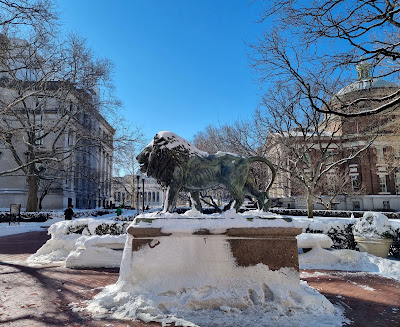
Columbia University In New York City

* * *

I'm standing outside Carnegie Hall. I've just slipped out of a rendition of Franz Lizst. An elderly woman walks up to me and takes my elbow. We strike up a conversation. She starts talking about the music, her roots in Hungary, her rendezvous with spirituality, and her time in the Himalayas. Fascinated, I enquire further, my eyes getting wider and wider with interest. 

She seems to enjoy my incessant gaze. She says she feels something in it, something familiar. Like we've met before, if not now, then in a previous century. I smile, but she insists. 

She continues to talk about her date with the divine. She talks about belief and faith. After ten minutes, my friends beckon that it was time to leave. As we say goodbye, she pulls me closer and looks deep into my eyes.

"Very soon, something magical will happen. Something magical, to some people." 

She smiles at me knowingly and walks away.

* * *

How can you not love New York?

The first time I saw that skyline, I felt a surge. It was like a shock, an electric current, a jolt through my entire body.

Despite a year of wide-eyed stares at this city's spires and silhouettes, I still feel it. At sunrise, when a mist envelopes the stone and brick giants, to sunset, when the glass monoliths glisten pink with reflections of the setting sun, I still feel it. 

Despite a year of feeling it, I still struggle to voice it. 

It's a struggle so real, so frustrating, so annoying that I just want to grab the nearest person and share how I feel. How I really feel. I'm convinced even my best attempt would still not do justice, if not destroy the sanctity of this experience entirely. But I want to try, despite knowing that I will fail. I want to try, try, try and try again in hopes that one day someone will see what I see, hear what I hear, feel what I feel.

I want to tell them that New York, not just the city but even the idea of it, is where I feel alive.

That the speed and ambition of New Yorkers is so palpable that you cannot help but imbibe it. That every street has a history so rich that I feel overwhelmed daily. That when I stand at the opposite shores of the Hudson or the East River, the Manhattan waterfront is as big a temptation to me as it was to a young, uncorrupted Robert Moses. That when I walk up the steps of the City Hall, I want to shake my fist at its white Georgian elegance and shout, "No more free lunch!" like Fiorello La Guardia. That when I hear stories of mafia wars in Little Italy, the lores of Hells Kitchen, Fort Clinton, Apollo Theatre, Madison Square Garden, or the tale of the Battle of Mothers against Tavern-On-The-Green, I'm as enchanted as I am inundated. 

That those who say Times Square is too crowded, too noisy, too dirty, too chaotic are missing the point. Amidst the kaleidoscope of digital screens, faces, languages, music and performances from across the globe, Times Square is not a standalone landmark, but at its core, just a mirror.  

That if you had to create a physical centre of the world, mildly representative of the richness of life, of its diversity, of its extremities, then one possible physical manifestation of that unattainable idea could be Times Square. Colours to chaos, cacophony to crowds, digital to dirt, everything good and bad about our world needs to be in Times Square to make it serve its purpose.

That when I crane my neck to look up at the Woolworth, Chrysler or the roof of the cavernous Grand Central, I feel as large as I feel small. That when I look at the Empire State, regal and imperious, I'm overcome by the dreams of people who truly grasped the full reality of human stature. 

That when I look at the skyline, particularly in the moments when I can't see the details but just the hazy silhouettes and the thoughts that made them, I feel shock, wonder and helplessness all in one. I feel like looking and kneeling like Howard Roark. I feel like throwing myself into space, over the city, over that skyline, over this scene.

Over the sky of New York and the will of man made visible.

I want to tell them that the thing I love most about this city is how much it humanises me. 

That this city's head start in architecture, history, food, fashion, theatre, comedy, music, dance or art is undeniable. That this city expands your perspective from Broadway to jazz to opera to comedy to television to pizzas to bagels to bialys is irrefutable. That you could spend every day of your life visiting a new gallery, museum, restaurant or theatre and still be left unsatisfied is inevitable. That from Koreatown to Little Italy to Washington Heights to Jackson Heights to Flushing, you could get a microcosm of hundreds of different countries and cultures in one dense region is insurmountable.

Geneva said this city doesn't care about anyone's love, and she's right. To claim ownership over this city, to call this city your home, is pointless. First, that statement would be ridiculously untrue. This city is unconquerable. It's wild, independent like Holly Golightly, untameable like Shadowfax. To call yourself a 'New Yorker' would mean the same as calling yourself the King of New York. Absolutely nothing.

Second, the city really doesn't care.

Maybe the allure of the unattainable makes the quest so enticing. It makes me restless. It makes me hold onto my angst, makes me want to preserve it, because I've realised I need it. That this city's intractable mysteries keep me sharp, on the edge, where I want to be. 

I want to grab this New Yorker, tell them everything, and still be mindful that I have barely scratched the surface. That I'm bursting at the seams to say what cannot be said, to grasp what cannot be grasped. 

I want to tell them that sometimes in the day I run. I run because I feel free. In a city that is the sublime personification of the furthest reach of the human spirit, I run to move the world. I run at moments when I could have walked, or not at all. I run to catch the train, to cross the sidewalk, to get that bagel, to attend that event, to board that ferry, to meet that person. To write my newest chapter. I run to give life meaning, to give it purpose.

That this is not just a city, but an institution, a dynasty. An empire state.

That sometimes in the day, I run, I run, and keep running as fast as I can, chasing what I cannot see.

I run for my destiny.

* * *

How can you not hate New York?

How can you not hate it with every fibre of your being, with hatred so deep, so putrid, so vile that your heart burns like an inferno?

I want to grab every proud 'New Yorker' and shake them. Shake them to wake them from this self-imposed trance, to make them see what I see, hear what I hear, feel what I feel. 

Shake them till we shatter this grand illusion.

Shake them till they realise that New York is in a perpetual state of decadence, if not already dead. That the Big Apple is a fruit that decayed long ago. That this is Gotham in all the vices, and there's no Batman in sight to save us. That the city with the most 'woke' people is also the one with the most asleep. That this is no longer the city where dreams are made but rather hissed and spat on. 

I want to show them that they could all pack their bags and leave tomorrow, and nothing inherent in the city would ever bring them back. It is the world's most elaborate Ponzi scheme. That the only reason this city is considered the hub of arts, culture and humanity is because of the network effect of people believing it still is. Present-day New York sustains wholly on this self-fulfilling prophecy. Yet, those most indispensable to any city, the ones that give it spirit, give it meaning, give it soul, are the ones it hates the most. 

I want to shake them till they realise that a city's primary objective is to facilitate living. To give people homes, communities and places of leisure. Yet, from stability to serenity to safety, this city gives you nothing. A home lacks everything a home should have. Houses are as unliveable in the summer as they are in the winter. Rents are unaffordable no matter where you go. The subway stations are still unable to withstand an hour of heavy rain. Getting a car is pointless. The subway will either deafen you or not show up at all, never in between. The parks are as suffocating as the streets, and as dangerous at night as unassuming they are in the day. 

That whenever I get an opportunity to get outside the city, whether in the valleys of the Hudson, the mountains of the Appalachian or even by the shores of the North Atlantic, I realise how much this city has changed me. How its personality has latched onto mine like a parasite, twisting and contorting, until we are one and the same. 

That in the moments I squirm out of this city's clinch, I feel a marked lightness, like a burden is off my shoulders. I realise how I never feel calm at night anymore. I realise I've stopped looking up at the blue sky when I walk. I realise I've stopped looking far into the horizon when I sit. How I've got so caught up in the energy, the madness, the chaos of this city that I've lost myself. 

That this city overwhelms you to always do more. To be everywhere, to eat everything, to see everything, to meet everyone. In seducing you to be someone it says you should be, it chips away at your former self. Under the lure of showing you the world, it eats up your soul.

That this city has an ego. It has pride, like an emperor, stubborn in denial, a shadow of its former self. 

That other cities don't strew their streets with filth. Other cities are not overrun by rats. Other cities don't contend with the constant smell of urine, vomit, weed and faeces. That residents of other cities don't function daily on a pulsating substrate of deep-rooted anger. Anger that is bubbling to erupt at the slightest inconvenience.

That the thing I hate the most about this city is how much it dehumanises me.

That I feel dirty within ten minutes of stepping outside, not just physically.  Other cities don't display the frivolity of life and its own cold apathy so blatantly. Other cities don't treat the dead and drugged, society's depraved, abandoned with insouciance, as an obstacle to step over for pedestrians.

That the cost of pursuing New York's depth in history, culture, fashion, technology or arts shouldn't come at a price so steep.

I want to shake them till they realise that a task as simple as walking on the streets shouldn't carry a chance of being shot, stabbed or mugged. I've walked at night in the empty streets of big cities of countries they might consider 'backward'. Cities that don't hold a candle in their eyes to New York. Not once, whether in Mumbai or Manchester, Tehran or Tbilisi, Dar Es Salaam or Doha, not once did I ever fear for my life. No other city serves its people so recklessly, so diabolically, so ruthlessly. That it took a brief trip back to Dubai to remember that stepping out at night didn't always come with lingering anxiety.

Shake them till they realise being a 'New Yorker' is not a badge of honour. It's a target on your back. 

That taking the train from Times Square shouldn't mean you might get pushed on the tracks. That walking in Downtown shouldn't mean you might get stabbed in the back. That people in other cities don't always say 'get home safe' during goodbyes, and mean it. That rape, murder, war and terror should only be a song lyric, not literally a shot away. 

That the value of a life should not be so meaningless, so inconsequential, so pointless.

I want to shake them till they know that I feel as lost in this city as my father did in Delhi forty years ago. That I feel unwelcome. That I feel dirty because this city stains my soul. That I fear this city, but I cannot turn back, spitting on the shoulders of the giants I stand on today. That I am the consequence of the power of an idea, a dream in motion, a thought in effect, decades in the making, generations in sacrifice.

That I hate this city the most at night. I hate it with a hatred so deep, so putrid, so vile that my heart burns like an inferno. I hate it because every night in New York, I'm afraid.

That sometimes, at night, I run. I run as I hear rustling at the corner of my eye, not knowing whether it's a rodent or a man with a knife. I run when I should've walked, or not at all. I run past lunatics, demented and deranged, the ones lost forever to the shadows, expecting a bullet to pierce my back at any second.

That sometimes at night, I run, I run, run as fast I can, afraid to look back, afraid to stop.

I run for my life.

* * *

I'm sitting in Washington Square Park.

On some nights, an unearthly haze descends on Manhattan. A plane of mist unravels over the city, dissecting all the towers neatly in half, their summits lost to sight beyond the fog. It feels surreal, bizarre, a world warped uncannily. 

Manhattan needs the sky.  

The sky is the anchor, a keystone for all these obelisks. It puts the end goal in sight. But on these unearthly nights, you can't see the sky. The towers are now headless stumps. There is no zenith, just an impregnable, suffocating sheet of haze, and the unknown beyond. It's one of those nights. 

Washington Square Park is privy to the ominous. After all, the park was built on a burial ground. The spots where the city congregates daily lie above the bodies of 20,000 souls. The elms under which picnickers sit were used for public lynchings. Paranormal sightings are common, whether at the flickering streetlight to the south, the weeping tree to the east or the bohemian dancing women on the arch. 

It's one of those nights.

You can almost hear the whispers in the wind if you're quiet enough. The whispers of the souls buried underneath the park.

A few months ago, a student was stabbed on campus. Last month, I was heading downtown when a friend called me to get off the train. There had been a shooting at the next stop. A week later, shots were fired in Chelsea when I was ten minutes away from getting there. 

I'm talking to a friend about my near escapes. I'm agitated. This city is playing with the law of averages on human lives.

A homeless man walks up to us. His face is shaded by the darkness, his eyes partially hooded. He leers at me.

A few seconds pass, maybe a minute, maybe an hour, maybe an eternity. I feel a prickle. 

I can hear the whispers again.

He tilts his head and rasps:

"Relax, you are already dead."

He leers at me, and I stare back at the void. I gazed into the abyss and the abyss was gazing back. 

He turns and walks off slowly. I turn to my friend, who is equally taken aback. I turn back at the man.

I had looked away for a second. He could've barely walked a couple of steps.

But when I looked back, he was gone.

* * *

New York was his town, and it always would be.

"The King Of New York?", he whispered, focusing on the Rockefeller, fiery in the sunset.

"By God, I am."
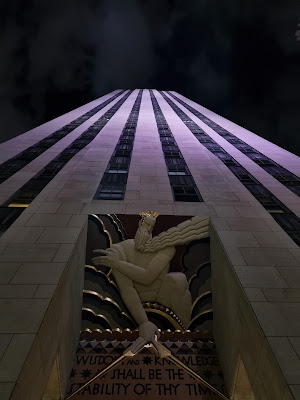
30 Rockefeller Center

* * *

Author's Note: If you liked what you just read then do help me by sharing this on social media platforms of your choice (Facebook, Twitter, Instagram, Reddit I ain't picky). We're all artists somewhere, in some field, and this is just my form of art that would truly find expression if more people get the inclination to read it.

Show your support corner:

- Share wherever you like (quick share buttons below for most popular social media channels).

- Follow Know Time, my talk show that focuses on celebrating curiosity: YouTubeInstagramTwitter

- Know Time (Audio): SpotifyApple PodcastsAnchor

- Consider donating to support this blog and the Know Time project on Patreon or Anchor 

- Follow me personally on Instagram or Twitter (for frequent memes, and occasional screams) 

Similar articles:

The Fortress Of Dreams: Read More

The Silence In The Dunes: Read More

The Cricket World Cups Of Our Lives: Read More

A City's Soul In Deira, Dubai: Read More

Sunday, 8 August 2021

The Fortress Of Dreams

For the audio version of this story, click here (YouTube) or here (Spotify) or here (Anchor).

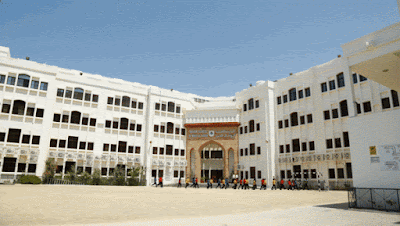
Indian School Al Wadi Al Kabir In Muscat, Oman

When I was two years old up to the age of four, for five mornings every week, at 7 AM on the dot, I remember being extremely unhappy. 

I remember clinging to my mother's hand. I remember looking at her with wide eyes, begging, pleading, often with a solitary tear, often silently, but screaming deep inside. On some days, the sadness and angst became unbearable for my tiny heart, and it gushed out in a mournful whisper:

"Mumma, main kab jaunga?"
(Mom, when will I go?)

I remember the afternoons of those unhappy mornings. When the Muscat sun was in its element, we heard the distant rumble of a bus engine, growing louder and louder like an omen. That was the first warning. My mother took a deep breath, chanted a few prayers and braced herself for pandemonium. I ducked for cover under our dining table, fingers plugged in my ears and eyes screwed up in anticipation. The bus came and went, and there was blissful silence for a few minutes. It seemed the danger had passed. I poked my head out of my shelter, ears still plugged, squinting through one eye to look at my mother. 

She still chanted soundlessly, knowing it was inevitable.

And then, with a screech that cleaved our home apart, our doorbell rang.

The earth shook as it rang and rang with a deafening din. Birds screeched in the distance. The dining table trembled, clothing me with sawdust and fear. Steel utensils fell to the floor, adding to the cacophony. My mother staggered through the world that was ending, eyes pinched against the bone-shattering clanging and opened our front door. 

A tornado of ebullience burst through, shaped indistinctly like my elder brother. For a while, we only saw a speeding blur that launched school bags, bottles, shoes, socks and books into every room it passed. Despite the wreckage it left in its wake, the twister chattered nonstop about this dreamland called school. Even when it settled, it yammered through mouthfuls of lunch, barely stopping to breathe. It boasted of dramatic cricketing feats and howled at uproarious pranks pulled on new friends. It doted on these lovely beings called 'teachers'. It spoke of all the adventures, friendships, happiness and love that I was missing.

Everything about it was irresistible. I was dying to go to this wonderland. I longed to be a 'big boy'. I longed to 'study' and answer important questions from adults like "What did you learn in school today?" and "What grade are you in?"

I remember the first time I visited my brother's school. I remember gaping at its giant brown facade, a small solitary figure swallowed by its vast shadow. The Indian School Al Wadi Al Kabir stretched for miles like the length of its name, like the meaning of its name. A giant fortress in the desert, a wadi unexplored, an adventure denied.

I remember it vividly, as it was the source of my unhappy mornings. On schooldays at 7 AM, my mother took us to the curb below our building to wait for my brother's school bus. As it rumbled over, I clung to my mother, my hands encircling her arm like vines on a trellis, beseeching for consolation. The bus conductor was a big, booming man named Prakash who smiled with his eyes more than his mouth. He put one giant foot on the road, with half of his body hidden in the minivan and the other half sprawling out like a genie from a lamp. He greeted my mother, winked at me, and beckoned my brother.

Faceless shrieks of welcome emerged from the shadows of the bus. My brother forgot his early morning tantrums in an instant. He vaulted in, flung his bag on his reserved seat and sat on his knees in reverse, facing the other boys. My mother and I waved at him as the bus rolled away, but my brother never waved back. He never looked at us. He was already deep in conversation with his friends. Peals of youthful laughter flitted through the bus windows as it sailed away towards another day of laughter, adventure and love.

"Mummamain kab jaunga?"

The pain was unbearable, unfair and suffocating. Time was my enemy. I asked my mother the same question every morning, usually with sad eyes accompanied by a tiny, broken whisper. I asked not to hear the answer but to soothe the throbbing ache in my heart.

My mother, to her credit, answered the same question for two years with unwavering love, pity and compassion. She didn't count the weeks, months or years till I went to school but rather the experiences I would have. She described the cartoons on my school bag, the shape of my water bottle. She listed the delectable delicacies she would put in my tiffin box and the loveliness of my notebooks. She painted a picture of classrooms and crayons so wonderful, so positive, so enchanting that I was already laughing by the time we were back home.

When I was four, it was finally time, and my excitement knew no bounds. We went shopping for my bag, water bottle, tiffin box, books and uniform. For days on end, I bounded around the house in full gear, carrying a Mickey-Mouse-themed bag and a camera-shaped bottle, as if school had begun early. I pored over my textbooks and empty notebooks, envisioning the letters I would write, the colours I would fill. I was finally going to that fortress I had dreamed about for years. I was so excited that I failed to notice the strained smiles on my parents' faces.

A week before my first day, my mother informed me that I wouldn't be going to the fortress. ISWK had constructed a small new kindergarten school, far off in the Muscat desert. Slightly taken back, I still maintained the spirit. After all, I was finally going to school, wasn't I? 

On my first day of school, my father insisted on dropping me in his car.

"No, I want to experience the school bus," I beamed. 

Years later, I discovered that my father had driven behind the school bus that morning, on the chance that I might start crying as kids on their first day invariably do. Yet Prakash reported to him that I sat silently on the tiny footrest they used as seats for the little ones, not speaking to anyone but just looking around with wide eyes, afraid to blink, trying to take it all in with just my sight, unable to contain a smile. This is it, here we go, my first day of school. I entered the class to begin my new life of happiness. 

In a few hours, I experienced the worst day of my life. 

On my first day, I sat amidst wailing girls and boys, miserably crying tears upon tears, filling up puddles by their feet.

"This? This is school?" I thought in disbelief for the entirety of those hours that stretched for years, for decades, for centuries.

Just an eternity of crying? An eternity of abject misery and pain? There had to be a mistake.

My mother beamed at me when I got home, hoping her son's day was filled with as much joy as he had hoped for years. 

"Kaisa tha pehla din?" she asked warmly.

I stared at her with suppressed tears, shocked by the tragedy, stumbling for words. I broke down, unable to comprehend if it was a huge mistake.

Over the weeks, as the kids' tears dried up and I started settling into school, I still felt incomplete. School was the formidable fortress my brother attended. This modest dull building in the middle of nowhere did not compare. My parents decided to carpool our morning ride, with driving duties split between my father and a friend's mother. Every morning, a car carrying four kids stopped first at the fortress, dropping off three of them. Then it sputtered deep into the desert towards my shanty, my nose pressed against the backseat window as I watched my brother and his friends disappear beyond the big white and blue gate.

Two years, my mother coaxed and cajoled. By the end of KG 2, my excitement was on the rise again. "Now, I begin school", I thought as I gambolled across the house. Once again, I failed to notice my mother's strained smile in my delirium.

A week before Grade 1, my mother sat me down to explain that ISWK had now shifted primary classes from the main school to expand intake. A dull new building, housing Grade 1 to Grade 4, had been erected next to my KG building in the extremities of the wilderness. My dream would have to wait for another four years.

The first year was easy since all four kids in the car headed to the same building. But a year later, we were back to dropping them off at the main school while I stared mournfully through the window. When I reached Grade 4, I was no longer oblivious. All year, I had heard the thudding hammer and grating saw. My mother sat me down to explain that they had added another floor to the primary school, to include Grade 5. 

Just one more year, she consoled, and I would finally go to the big school.

Nearly a year later, a month before I would have finally started classes in the main school, I had my face pressed against a car window once again. But that afternoon of April 7th was different. We were moving permanently to Dubai, away from the only apartment, building and city I had called home. 

I never walked through the gates of the main school, the fortress of dreams.

I haven't returned to Muscat ever since.

* * *

What have you done?

You either die a window seat loyalist or live long enough to see yourself picking aisle seats on flights (if you prefer the middle, then you'll be pleased to hear that there is medication for what you have). Ever since I reached the age of reason, I scoffed at window seats. Two minutes of good views on the fringes of hours of darkness were not worth perching like a tarantula with legs bent where they shouldn't be bent.

My loyalties started to sway on my annual redeye flights from Manchester to Dubai. As the flight descended on the lands of Arabia, I craned my neck from my aisle seat to steal a glimpse outside the window. Darkness was all I saw. Impenetrable, spreading all across and beyond, unrelenting in its uniformity. I yawned, stretched, hit my knee in the process, cursed aloud, whispered an apology, checked the time and returned to waiting. 

After minutes that felt like hours, hours that felt like years, I heard a whisper from a window seat. A child tugged his mother, pointing excitedly into the void. I craned forward once again. 

This time, I saw it.

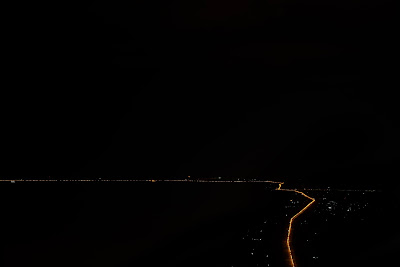
Far off in the abyss, one small golden dot had blinked into existence.

Then another, and another. In a matter of seconds, like golden dominoes toppling into sight, lines of dots emerged at the horizon. Yet, there was structure in their formation.

In 1903, the Argonaut anchored off the shores of the Trucial States, as Lord Curzon did not deem the land worthy to set foot on. Instead, he welcomed the sheikhs onboard for a durbar. 

"We found strife here, and we have created order," he exclaimed bombastically.

A century later, peering out of an airplane window, I did see order in the desert. 

But it was not the British who had created it.

The dots were streetlights. They snaked out like tendrils, linking up with other patterns emerging from the sides. As we flew, the roads of the Emirates emerged thousands of feet below, awash with bright golden light, twinkling in the haze just like the stars in the heavens above. As I watched the child try to trace the lights towards the horizon, a destination was apparent. There was a purpose, a crescendo. With gradually increasing radiance, all paths led towards a giant golden dome of light on the horizon. It was something extraordinary, still hundreds of miles away, still indistinct, yet ominous in its presence.

It had the mark of a creator, divine and powerful. 

At that moment, I stopped craning my neck to look outside the window. I settled back into my inferior aisle seat, sheepishly muttering apologies to the passenger in the middle for nearly sitting on his lap. 

I sighed.

All year in Manchester, I lived a stranger's life. When you're a young student, it's easy to get lost in certainties. Of course, you are supposed to study, revise, party, travel and repeat it all over again. Of course, you are supposed to go back every semester. Going to school, moving up grades year after year, then going to university and doing that for another four is just part of the plan. 

You are supposed to do it. There are no big decisions to be made, no conscious thought.

I always lost myself in those certainties in Manchester. My past was safely ensconced away on the dark side of the mind, unused until further notice. I was connected faintly with friends, family and old memories yet detached. I was supposed to ignore it. There was no time or point. I had grades to achieve, memories to make, a life to live.

Those shackles weakened earlier that day when I first saw it.

I was standing at the airport departure gate, gaping at the object beyond the high glass windows. It was a gleaming, pristine aircraft with fluidic calligraphic lettering on its flank. It had welcoming colours of red, white, black and green on the rudder. 

At the other end of the world and in a completely different life, a convoy sent by my past. 

At that moment, I felt a shadow of a thought, almost a sense of deja vu, fledgling and innocent, not yet stirred into an opinion or emotion. 

That shadow of a thought grew as I watched the flight screens play introductory videos in Arabic. It grew as I fumbled for a grimy sim card, dumped unattended for a year in a spare spectacle case. It grew and grew as the flight speakers crackled with the melodies of the oud.

Finally, near the end of the journey, it happened. As I drifted in an ocean of twinkling jewels, in the sky above and ground below, the thought took shape. Before the pilot crackled landing instructions, stewards glided over collecting disposables, seats buckled and unbuckled, overhead carriages shut and opened, for a brief moment, I found peace, joy and silence before the chaos. 

I found order in the strife.

I was finally home.

Dubai Lights At Night Aerial View

* * *

"One of man's oldest dreams is to turn the desert green."

In 1979, Queen Elizabeth II inaugurated the World Trade Centre with her royal scissors and majestic proclamations. 

In 2005, when my father's Toyota Camry entered Dubai, the World Trade Centre (now the Sheikh Rashid Tower) barely featured in a list of must-see places. Even if you sympathized with the former tallest building of the Middle East, what then of the others? Can you proffer your sympathy to the Emirates Towers? Deira Clocktower? Burj Nahar? Fish Roundabout? Deira City Centre? Burj Al Arab? Even if you squeezed them all in, with Dubai's prodigious love for the Marina or Palm, can you secure a spot for the Creek today? 

Where bedouins, or bedu, napped while floating on extremely salty waters to combat the heat. Pearling vessels floated out, carrying divers with noses clipped shut and weights tied to their feet. Dhows coasted in with lateen sails, bringing Persian wares, and soon the Persian merchants themselves. In 1938, it mediated the uprising of Dubai with the rulers in Bur Dubai and the rebels in Deira. The creek that built this sleepy fishing village and then divided it. 

Today, if you looked at Deira across the creek, you would see a set of geometrical buildings that were once the original skyline of Dubai: the convex National Bank of Dubai, cylindrical Rolex towers, triangular Chamber of Commerce and spherical Etisalat globe. If you stood on the opposite end, you saw the influence of migrating Persians in the Bastakiya district, badgirs jutting out of the mass, abras flitting voyagers across the channel.

They say big, old cities like New York or London or Delhi or Bombay feel like they are never yours. They make you feel lost. No matter what you do, those cities have existed for centuries without you and will continue to exist for centuries more. You are nothing but a temporary speck, a petal in a field, replaced every year. 

The Dubai I grew up in was neither big nor old. But it still wasn't mine. 

I was still lost. 

An orchestra conductor walks on stage and climbs onto a raised platform. He dusts his tuxedo, snaps his spotless white gloves and stands up straight. A momentary pause, and then he points the baton to his left.

I hear "This city has no future" from an uncle shaking his head, arms folded in defiance. We were celebrating his 60th birthday in his gilded mansion. He had lived more than half his life in the city of no future.

The conductor snaps the baton to the right. I hear "I don't have freedom here" from friends in a pub, irony effervescing like the froth of their beer, as iridescent spots of light sporadically light up our table.

The baton points to the middle. I hear "The market is down" from clients as they network at hotel lounges, pose for flashy awards and splurge on lunches and brunches. For two decades, I've never heard of the market ever being 'up'.

The baton swirls around, and I hear "There is not much to do here, there is no culture" from people who only visit the same cafeteria every evening for karak.

The tempo rises, the loudness gets painful. I hear "This place exploits workers," and heads nod in unison.

The tempo rises and rises. I hear "It feels fake, feels artificial," and "We have no stability," and "We can't call it home." The same routine, same tunes, same beats, repeated year after year. It gets faster and faster, building in crescendo, until I'm back under a table, ducking for cover, eyes screwed up. It gets louder and louder, with crash and clamour, and the world is ending. I stagger through the racket, ducking under vicious debris, to stop it the only way I know. 

By agreeing with everything I hear. I agree, piling dust and sand back on the shine, and just like that, there is silence again. 

You got me, I'm convinced. I'm eulogizing a showpiece city, foolishly inebriated by the romanticism of youth, delirious in Dubai. 

I must leave.

Yet, even in my self-imposed alienation, this city has a way of creeping up on me. A moment comes, which comes rarely but comes with force when it does, when I'm standing at Bluewaters, or the Palm Crescent or Sheikh Zayed Road, dwarfed by the magnificence of Ain Dubai or Atlantis or the Museum of the Future. A moment comes when I'm cruising dreamily on Garn Al Sabkha or Al Khail road, and the columns of Dubai Marina or Downtown Dubai rise into existence. As I get closer, the shapes begin to take form with the fluidity of a dimmer switch. The edges cut across the sky at astonishing heights.

The silhouettes sharpen, and I see it.

Spires of glass, glistening like crystals in reflected sunlight, piercing through the clouds. Higher, higher and higher. Towers of sparkling diamonds, testament to human ability and spirit, built on heat and sand.

At that moment, it hits me. The magnitude of this city's accomplishment, its audacity, its insolence. I'm struck by a single thought, one that surges through like a bolt of lightning:

What have you done?

How dare you do it? Who said you could do it? How many doubted you? How many never looked your way? Unable to come to terms with giving up their homeland to make more money, they tried to explore your darkness. They speak of history but never visit your forts, tombs, falajs or wadis. They speak of culture but never explore your art, architecture, poetry, music or theatre. They don't try your luqaimatshassan mattars, shawarmas, Pofak chips, date milkshakes, Areej juices or porotta wraps. They don't see the vintage Toyota or Lexus with decals all over, tinted black, still flaunted with pride. They don't feel the lethargic Friday morning lull when Dubai sleeps while the world still works.

Despite your apparent vices, they stayed and continue staying, grumbling publicly but afraid to confront the truth of going back home. 

You were the village on the Pirates Coast that a British general described as 'enjoying the safety of being undesired'. Now, they don't doubt, don't question, don't ignore. Now, they see, they marvel, they gape. Now, tourists stream in for luxury and leisure, descendants of guffawing generals stream in for tax-free havens. From barastis to the Burj, you defied the prophecy. The makers, the divine creators, locals and expats, hand in hand, creating order in strife, turning the desert green.

Once the city with no future, now the city of the future.

What have you done?

Today, I leave this city for New York. A city that is a grandfather of urbanity compared to Dubai's infancy. I leave to be a petal in a field of the quintessential metropolis, a grain of sand in the Rub' al Khali. At the cusp of this nation's 50th year, a month before its biggest global event in history, I leave it. As it sheds the final scraps of reticence and steps forward on stage announcing its ambition, I slip out the back door.

I left Muscat in search of a home. Despite a decade in Dubai, I'm still bothered by a question: did I find it here?

I don't know. All I know is that as I grew up, this city grew with me. We are entwined, this city and I, hand in hand, heart and soul. We still call it the Sana signal, but there is no Sana. The Sukh Sagar street but there is no Sukh Sagar. We still say it's next to 'Al Nasr Cinema' or 'Ramada Hotel'. Still reminisce Musalla Tower's dragon and Lamcy Plaza's clown. 

I marked the Burj Khalifa's ascension in my mind, like a mother notching her son's height on his bedroom wall. As I got taller, its spires reached higher. As I moved faster, the golden lights reached out even further, swallowing the desert. A mist, a shadow, a thought spread through this city and me, in our hearts and soul. It spread through the dunes, through the heat, taking in the barren wasteland to create hope, ambition and dreams.

We were the ones born in the dark who stayed around for the sun, this city's midnight's children. 

Can you take that away from me?

Dubai Skyline Burj Khalifa

* * *

If you liked what you just read then do help me by sharing this on social media platforms of your choice (Facebook, Twitter, Instagram, Reddit I ain't picky). We're all artists somewhere, in some field, and this is just my form of art that would truly find expression if more people get the inclination to read it.

Show your support corner:

- Share wherever you like (quick share buttons below for most popular social media channels) (sorry Orkut, you didn't make the cut)

- Follow Know Time, my talk show that focuses on celebrating curiosity: YouTube, Instagram, Twitter

- Know Time (Audio): Spotify, Apple Podcasts, Anchor

- Consider donating to support this blog and the Know Time project at Patreon

- Follow me personally on Instagram or Twitter (for frequent memes, and occasional screams) 


Similar articles:

The Silence In The Dunes: Read More

A City's Soul In Deira, Dubai: Read More

Master of all Nations, Citizen of None: The Life of a Gulf NRI: Read More

Saturday, 18 July 2020

The Silence In The Dunes

dubai curfew during the CoVID-19 corona pandemic

The balcony in our apartment extends to my room but doesn't open up to it. Instead of a door, I have to contend with a window overlooking my own balcony. I don't mind it as I would rather be in than out, given Dubai's propensity for heat and dust. But due to the strategic placement of my window, I am privy to most events in my balcony - which, we can all agree, is any young man's dream.

My role as the sentry of our balcony has its moments. When two birds get into a heated squabble on the railing, I am the first to find out. When our flimsy clothes drying stand tumbles over in the wind, I am the first to find out. Of course, by the time I rush outside to pick it up, our freshly washed clothes are beyond salvation from a thick layer of dust, but that doesn't undermine the fact that I find out first. 

Knowledge is power, after all. 

Occasional rack tumblings aside, the most significant event on our balcony occurs every morning. My parents like to begin their day sitting on our swing, sipping their daily chai in the morning chill, as they gently rock to and fro watching the sun rise over the horizon. Ironically, while I am aware of all trivial events in the balcony throughout the day, from tumbling dryers to squabbling birds, I am not privy to the only significant one in the morning. In the early hours of the day, when my parents commence their balcony routine, I am unerringly snoring away. I don't wake up until the sun is well and truly up (and blazing hot), and until my parents have already completed all their morning chores.

Even if I could manage to wake up at daybreak (a lost cause at this point, frankly), I wouldn't dream of interrupting my parents' daily tryst with destiny. It is their treasured time to themselves in the quiet hours of the morning, sipping chai with great relish. Their moment of solitude before the chaos of the day ensues. At that time, when the world sleeps, it's just them, their thoughts, confessions, supporting words and the chirping of birds. Over time, they have even developed a penchant for birdwatching, pointing out parrots, sparrows and crows with joy. Watching a flock of sparrows soar gracefully around our community adds to the poetry of the moment.

Due to the proximity of my window, at times I am abruptly woken by my father's loud rant on politics. My mother, on most occasions, is perceptive enough to shush him. 

"Thoda dheere bolo, Shalaj so raha hai," she admonishes.
(Speak softly, Shalaj is sleeping)

Soothed by the subdued voice of my father and the caresses of motherly love, I drift back to sleep quickly. 

On other days, I am woken by an uproar, stoked by my mother scolding my father on his latest act of mischief. On these days (which my father insists come rarely), I have no one to shush my mother in turn, as no man in our house would dare think that thought. So as my father gets his (deserved) rebukes, I have to endure them passively too, with my mother's fury effortlessly seeping through the flimsy window pane separating the scene of crime and my room.

However, on that day, that sultry morning in April, there were no loud voices on the other end of the window pane. Yet, I woke up. As I lay in bed, trying to will myself to sleep, hoping to catch a few more hours of blissful dreaming, my mother's sombre voice floated through the window.

"Kisi ne socha bhi nahi tha ki kabhi aisa hoga."
(No one had ever thought something like this would happen)

My father, in a rare moment, said nothing. The words sunk into a heavy silence, interrupted by their sips of chai and the setting of the teacups. Even the birds were quiet that day as if they were acknowledging our ruminations. No sparrows soared in the firmament. My mother's words hung with a certain heaviness, and unknown to her, seeped into our house, twirling and swirling, impeding my attempts to fall asleep again. Something about the way she said it exuded a force that I had hardly felt before. It was probably what woke me up in the first place. 

In 2020, just like that, my life had come to a standstill. 

Even my parents, just like the world around me, had gone quiet.

* * *

Life in Dubai had always been hectic. On the road, you were either speeding at 140, or being flashed out of your lane by someone who was or inching along in a logjam. The speed radars constantly flashed like paparazzi cameras. At work, you were writing an email, while on a call as you wolfed down your lunch in the pauses in between. In the malls, you were jostling crowds and standing in queues. You were guaranteed to make at least three rounds of a full parking lot before you spotted someone heading towards their car that you could tail. In the restaurants and shisha cafes, you were constantly checking your phone, setting alarms, rushing off to renew an expired parking ticket or being passive-aggressively booted out by the waiter trying to serve the customers queuing outside. At home, you barely got through your daily chores before you crashed out, ready to do it all again the next day.

At some point in the week, when two people would discover a rare moment of repose, the frenzy of this city would become apparent. Inevitably, one of them would sigh and lament: 

"Time flies too fast here."

Somehow, time as a dimension, as a continuum, followed different rules in Dubai. Everything about Dubai was about speed - growth, development, economy or vision. We got things done here, and we got them done fast. For a fledgeling city, one way to stand with giants was to convince them that it was precocious. I had watched the Burj Khalifa get constructed, floor by floor, week by week, as my school bus whizzed past it in the mornings. I had seen nothing but a sandy desert where the Dubai Marina launches cruises today. I had felt nothing but infernal heat at the spot where penguins roam in Ski Dubai today. I had seen nothing but the vast and unyielding Arabian Gulf at the spot where the Palm Jumeirah sleeps today. When we moved in, there was no Downtown Dubai. The tendrils of growth snaked out with alacrity from Bur Dubai and Deira, and today pictures of the city from the early 2000s are unrecognisable.

All of this, and more, in just a decade. 

I had not known a Dubai that knew anything else. It was a child prodigy trying to impress the adults with the exuberance of his youth. Those who couldn't, or wouldn't, keep up got replaced by ones who did. Every year that I returned to Dubai for vacations from university, it felt like I was visiting a new city. New restaurants and shops replaced my old haunts and new roads had emerged while older ones had vanished. New skyscrapers, new rules and new people were to be expected every single visit. The only constant was change. 

Every day, the city moved at breakneck speed, of that there was no doubt. 

But at what cost?

In the middle of that frenzy, we first heard a murmur. A virus had started to spread in China. Yet, we shrugged it off - somehow global events never passed through the Middle East. I had often felt detached from world events in this region - to my frustration in my teenage years, nothing major of interest ever happened here. In the 2000s, there were no rock concerts, cricket matches or movie premieres. On the other end, there were no wars, tsunamis, riots or earthquakes either. The disconnect came at a price but allowed us to enjoy a rare era of peace and stability. Global catastrophes felt like problems of the world outside, of which we remained aloof. 

When the swine flu pandemic ravaged the giants, we hardly noticed it. Our school simply put a tissue box in each classroom as a gesture of goodwill, and we carried on. When ebola ravaged Africa, it got honourable mentions in off-hand discussions at get-togethers but remained largely inconsequential. 

So when we heard a murmur, we forgot about it. This was a problem of the world outside. We continued zooming about, tangled in the chaos of city life. Then the rumours got louder, and it became a conversation starter. In March, something was afoot. Something mysterious, unseen and uncontrollable. Then suddenly, the news burst through - the fortress had been compromised. JLT went under lockdown, with One JLT roped off. That evening we went to buy groceries to find the shelves half-empty, with people stuffing their trolleys with every possible item in sight.

One by one, places started closing down. First, it was my gym, then the restaurants, then the hotels, malls, parks and beaches. The cases increased daily, the graph arcing upwards with brutality, hinting that it was still only at the base of the mountain. Darkness started to spread across the city, enveloping it, and seeping into our homes and hearts. Panic and anxiety took the reins. 

In April, the first curfew was announced. No one was supposed to be out late at night in a city that had built a reputation for a thriving nightlife. Earlier, whenever we used to head home late at night, my father would usually exclaim:

"Dekho sadak par iss waqt par bhi kitni gaadiyaan hai, kitni roshni hai."
(See, even at this time there are so many cars on the road and so much light)

Across two decades in Dubai, I have never seen the main roads deserted. Even at the darkest hour of the night, there was light. But in April, I saw them empty with not a soul in sight. Empty and desolate, even in broad daylight. As the cases kept increasing, the late-night curfew became a full day curfew. Pictures of a deserted Sheikh Zayed Road started circulating on WhatsApp. Daily commuters inured to its beauty were served a timely reminder. The emptiness revealed the road's inherent magnificence, its symmetrical majesty.

But, it was also equally haunting. It felt wrong.

As beautiful as Sheikh Zayed Road is, with its columns of skyscrapers standing guard like majestic sentinels that usher entrants into the city of the future, it deserved to be filled with cars, its curbs packed with pedestrians, the parking spaces occupied and the metro gliding past. If that road is the emblem of this city, then it needed to be perpetually in flux, with life constantly flowing down it like a stream.

That week, it was barren. Like the dunes that once rested in its place. After years of fooling time, we had started to go back. 

That was when it sunk in.

The silence hung over us like an iron curtain. For a while, experts believed that the virus might not survive in extreme heat. Ironically, very soon the sun, our eternal blaze, was blocked out by dark clouds. Thunderstorms, rare for Dubai and rarer for Dubai in April, slashed across the city. The pervasive gloom added to the curfew. We huddled at home, afraid of an unseen, unknown and unbeatable enemy. Even stepping out of my door into the building corridor felt like I was heading into the trenches of a war zone. Every person, door handle and item was treated with suspicion and paranoia. We set up a sanitisation space at the entrance of our home, to stop the virus at our doorstep whenever we stepped out. Anyone returning home had to wait for someone at home to open the main door and open all the doors on the way to the dedicated sanitising washroom. The footwear was left at the door.

Those who wished to drive in streets needed a permit, which was granted only once a week for essential tasks. My father, the sole family member to step out during the curfew, found only empty streets and barricades on the roads he once saw life and light even at the darkest hour. 

Even him, who had taken a bus through Delhi in the aftermath of the Sikh massacre in 1984, having described that as the darkest event he had ever witnessed with a scene of decadence and death trailing his wake, found himself surprised, at a loss of words even. Even for him, despite having lived in a world with Indo-Pakistani wars, communal riots and 9/11, it felt odd, felt wrong, to see his Dubai so desolate, empty and apocalyptic.

I had always associated this city with speed, activity and chaos. Not having known it to be anything else, I had taken it for granted, even vilified and complained about it. But it took the stillness, the gaping silence in the abyss, to show me that the city needed its speed. The hustle was so ingrained in the city's culture, that it was the culture. It needed its bright lights, large crowds and loud noises; a haven teeming with life. 

Without it, it felt wrong. 

For the first time in the millennium, Dubai had gone quiet.

* * *

Three months later, my parents' conversations on the swing have nearly returned to familiar territory. Once again, they swing lightly to and fro, sipping chai, while chatting merrily about their life, kids, local gossip, my father's job, his misbehaviours (some things never change, I guess) and to my extreme distaste, my marriage prospects.

I say nearly returned to normalcy because the virus is still with us. Refusing to be eliminated, it has become a part of our lives. It still persists as an underlying context in all those morning chai topics.

Even beyond our balcony, Dubai is nearly back on track. The roads are packed and there was a certain (albeit, short-lived) joy in seeing a traffic jam again. The parking spots are elusive again. The beaches, restaurants, malls and pubs are full again. The cases are on a decline and stringent measures are in place. 

Once again, I say nearly back on track. The mask is now a part of everyone's attire. Gatherings are still restricted, arenas are still shut and theatres are running at limited capacity. People largely stay distant, handshakes have thankfully been discarded (hopefully forever) and the huggers probably burst a vein every time they spot a friend.

The optimist would see the city half full. The pessimist would still see all the prevalent restrictions, covered faces and shuttered shops. Some of those shutters will never open again as we enter another recession. There will be hardships and with it copious amounts of blood, sweat and tears. Some darkness will still persist, inhibiting and oppressive. 

But this city, the only one that I can truly call home, will endure.

At this point, it is hard to predict when. But I know a day will come when the birds will fly again. When once again, as the sun rises while the world sleeps, my parents will wake to a Dubai filled with light and freedom.

Dubai Quarantine Curfew during CoVID-19 Corona Virus


* * *

If you liked what you read then do help me by sharing this on social media platforms of your choosing (Facebook, Twitter, Instagram, G+, Reddit I ain't picky). We're all artists somewhere, in some field, and this is just my form of art that would truly find expression if more people get the inclination to read it.

Show your support corner:
- Share wherever you like (quick share buttons below for most popular social media channels) (sorry Orkut, you didn't make the cut)
- Like the Instagram post here (and follow me personally, if you like my non-existence aesthetic)
- Follow me personally on Twitter here (for frequent memes, and occasional screams) 
- Like this blog's Facebook page here
- Follow the Blog Twitter feed here 
- Upvote this piece on Reddit here

Title picture credits: Naomi D'Souza

Similar articles:

The Pursuit of Happiness in Zanzibar: Read More

A City's Soul In Deira, Dubai: Read More

Master of all Nations, Citizen of None: The Life of a Gulf NRI: Read More